I spoke earlier of how important speed is in determining what mode of transport is dominant and how it will shape the developments that will grow in an area. But in determining the ability of a transit line to attract users, there are actually two main factors:
- The average speed of the line (commercial speed)
- The frequency of the line
If we suppose that people randomly need to go to certain places, meaning they do not choose the moment of their departure, the time to reach the destination is not only the time required while in the vehicle, but the time to get to the stop and spent waiting at it. That waiting time can be estimated at half the frequency of the line, so if there is one vehicle per 10 minutes on a line, the average waiting time should be 5 minutes. This would include the waiting time at home if the schedule of the line is known for the user.
The frequency of a transit line is primarily the result of the capacity per vehicle and the ridership of the line. The more riders a line has, the more it justifies putting an higher number of vehicles running on the route, increasing frequency.
For example, if a transit agency has a standard of offering one bus per 40 passengers in the hour on a line, then we can draw a graph illustrating how the frequency of the line will vary depending on the number of passengers on the line per hour. It would look like this:
 |
| Graph illustrating the relation between frequency and ridership |
So considering that the waiting time is half the interval between vehicles, it looks like a virtuous circle. The more riders there are, the higher the frequency. The higher the frequency, the shorter the waiting time. The shorter the waiting time, the faster the trip will be. Great, right?
Unfortunately, that is not quite accurate, at least, not with regular local bus service (streetcars have the same issue most of the time).
The problem is that these lines are characterized by a great number of closely spaced stops, around 200-250 meters between each (1/8 of a mile). The stop spacing has a great influence on the speed of the vehicle while it is in movement. By supposing an acceleration and deceleration of 1 meter per second squared (a decent estimate to insure comfortable accelerations and decelerations for users) and a certain time stopped at each stop (including stops due to stop signs and traffic lights), we get the following curves representing the average speed of vehicles depending on how far they can go without stopping on average. Each curve represents a different maximum speed.
 | |||
| Average speed of a transit line versus the average distance between stops |
For miles per hour, divide by 1,6.
OK, a bus can still get a decent speed despite a great number of bus stops if most of these are unused, as it doesn't need to stop at each bus stop, only at those where people get in or get out. That means that the less people per kilometer board or get off the bus, the faster the bus will go.
Oops. This is no longer a virtuous circle here! The higher the ridership, the slower the bus will go. If I model this dynamic, supposing a bus route on urban streets where normal vehicles go at an average of 23 km/h (15 mph), this is what I get.
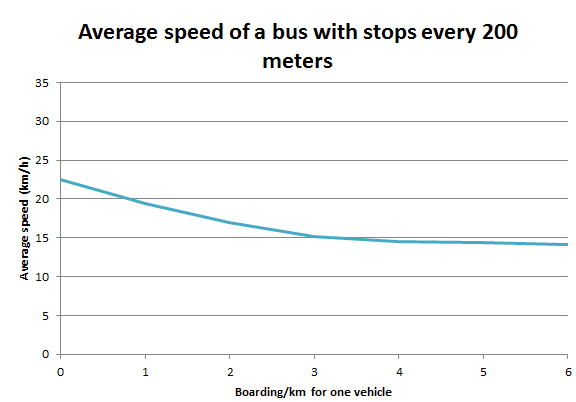 |
| Average speed of urban buses versus the number of boarding per km, supposing bus stop spacing of 200 meters |
Now, this was in a rather urban area with a lot of stops and traffic lights will slow down all vehicles, but even then, with even just 3 boardings per km, the bus will move around 40% slower than cars. This is also true for suburban buses on roads with few stops and lights.
 |
| Average speed of suburban buses versus the number of boarding per km, supposing bus stop spacing of 200 meters |
So that creates a big problem for local transit lines, a dilemma if you will:
1. If ridership is high, then the waiting time will be short, but it will take more time getting anywhere on the bus as it will be slower
2. If ridership is low, then the waiting time will be high, but once on the bus, the speed will be similar to that of cars taking the same route
So in either cases, this is an inescapable pit of mediocrity compared to cars' speed. Either frequent and slow or infrequent and fast, but never frequent and fast. That's why these local transit lines traveling next to cars can never really contest the domination of cars. And in urban settings, often biking will be faster than buses, so in a walkable, bikable dense city, buses are virtually useless for most people.
Note that the reality is even worse than that, as bus drivers are on a schedule, and the only way to maintain that schedule is to build in excess time so that buses can catch up to the schedule if there are more passengers than expected. What this means is that if there are less passengers than expected, bus drivers will slow down not to arrive too quickly to the next stop, since being late is one thing, but being too quick is more than just a little annoying to transit users who see the bus passing before them as they're walking to the stop.
What this underlines is the importance of rapid transit investment with grade separation so that transit can be at the same time high-capacity and high-speed, which is necessary to compete effectively with cars. To satisfy oneself with simple buses running on shared streets is to be satisfied with transit remaining a marginal mode of transport which will take 2 to 3 times more time to get anywhere, in the best case scenario.
Mitigating measure
This problem can be somewhat mitigated, but never eliminated, by eliminating bus stops and thus having a greater stop spacing. This way, you can cap the amount of time buses will have to stop to pick up or let off passengers even if ridership increases. As the buses stop less often, they can maintain their speed better.
 |
| Average speed of an urban bus line depending on boardings and stop spacing |
Greater stop spacing does mean that people will have to walk greater distances, but it's a trade that's worth it if the goal is to make transit a competitive way of getting around and to increase ridership rather than to perpetuate the conception of transit as a form of welfare program made exclusively for those too young, too poor, too old or too sick to drive.
As an added bonus, if buses are faster, as most of the cost of running them is in the form of wages, it means that their costs tend to be proportional to their time running rather than distance traveled. So if you speed up buses, that means that you can increase the frequency of lines for a negligible increase in costs as the buses finish their routes faster and thus can be sent back to do another route quicker. If you can afford 4 separate buses on a route and this route takes 40 minutes to run, then that means each bus can only do 1,5 time the route each hour, for a frequency of one bus every 10 minutes, 6 buses in an hour. But if you speed up the buses by 30%, then the route takes only 30 minutes to do, the same 4 buses can do the route twice every hour, for an interval of 7,5 minutes between buses, with 8 buses an hour from the point of view of riders. This increases frequency and capacity of the line, all for a minimal additional cost (mostly gas).