Monday, July 7, 2014

Sidewalk design fail: when pedestrians prefer bike paths to sidewalks

I've noticed something I have never thought about before, even if it was right in my face for nearly 25 years. I come from the Québec suburb of Boucherville, which, as far as North American suburbs go, isn't that bad. Sure, the population density is low, but streets aren't too wide, averaging 7-8 meters (24 to 27 feet), most streets have sidewalks on at least one side, elementary schools are largely located in the middle of neighborhoods, within walking distance of most kids, there are some groceries and proximity stores inside residential areas, the city zoned for multifamily apartments along primary streets (where buses are) and near stores, lots of trees...

Small apartment blocks along a  relatively narrow collector street, note the bus stop to the right

Planters serving as pedestrian refuge at a crossing of a main street

Narrow residential street, with trees on either side enclosing the street well
This is a residential street, not a main street, but there are sidewalks on either side and the street itself isn't so wide
At the same time, it still has low density overall, and stores have huge parking lots in front. Some places are quite far from anything, the walk score of my childhood home is 13, but one street over to the west, it's 2. The bus routes make loops inside the city and are almost useless to travel within it, their use is strictly to take people to the nearest subway station, either in Longueuil or to Radisson station on the island of Montréal.

Anyway, one of the things the city has done, being almost a precursor in that regard, is building bike paths on its main streets.
Boucherville and its bike infrastructure
This is what the bike paths look like where I lived, which has been around as long as I remember, so about 30 years (feeling old here):
Bike path in Boucherville
So one asphalt path aside from the street. But in fact, I've not been entirely accurate, this bike path, like many others, are not actually bike paths, but "multi-purpose paths" (piste multifonctionnelle in French). Essentially, it's not only for bikes, but for roller skaters, pedestrians and all active modes of transport. About the only things banned are motorized vehicles. Hence why in the latter photo there is no sidewalk on the other side.

Okay, so where am I getting at? Well, I've noticed a particular phenomenon at work. In places where there is a multi-purpose path on one side of the street and a sidewalk on the other, pedestrians will, almost 90% of the time, choose the multi-purpose path. How is this significant? Well, the sidewalk is supposed to be the place for pedestrians, yet, when given a choice, pedestrians in Boucherville will prefer the multi-purpose path, a path built primarily for bikes where they are forced to shared the path with cyclists.
Multi-purpose path on the right, sidewalk on the left... pedestrians on the right only
 Now, I know what you may be thinking: "Well, there are trees giving shade on the right and apartment blocks on the left, maybe it's not about the design of the paths but simply what's beside it". Except this next photo...
 
Again, pedestrians opting for the bike path rather than the sidewalk
...shows a place where the sidewalk borders a PARK. You know what's next to the bike path? Railroad tracks, used only by freight trains. Still, people choose the bike path, they will even cross the street to walk on it rather than on the sidewalk.

And I've found a more evident example of pedestrian preference on Street View. This is in Laval, on the Boulevard du Souvenir:
Sidewalk and bike path side by side, everyone in the bike lane (Boulevard du Souvenir, Laval)
Note again how pedestrians keep opting for the bike path rather than the sidewalk... a few feet away!  

And yesterday I was biking in Longueuil and saw this place with bike paths in gravel and sidewalks on each side of the street:
Longueuil, bike paths in gravel in the median, sidewalks on the sides
I didn't take a picture then, but I guarantee you, all the pedestrians I saw were on the bike path, none on the sidewalks.

So what gives? Is there any lesson to learn here about pedestrian infrastructure? Personally, the first thing I get from this is that pedestrians don't actually seem to like the standard North American sidewalk. Maybe it's too narrow, maybe it's too close to cars, either parked or in movement, maybe the curb cuts are annoying, maybe the way it's built is not all that comfortable (concrete blocks with evident joints).

I also get that pedestrians largely do not care about having to share a space with cyclists. Sport cyclists may hate it because the presence of pedestrians forces them to slow down when passing them (like car drivers who hate having to pass slower cyclists on the street), but it doesn't seem to bother either pedestrians or cyclists overall. It seems that since both pedestrians and cyclists are very vulnerable in a collision, and both know it, they can easily travel alongside one another, both will be careful of the other and take care.

Maybe my experience in Boucherville is what made sure I wasn't out of my element on my Japan trips when I had to walk on sidewalks shared with cyclists. I did also much prefer the way the Japanese build their sidewalks to the standard sidewalks here.

So, should we revise the way we build sidewalks in North America? Is it just a case of a bad design we keep on using because, well, that's how we've been building them for a century or so and it's the standard?

Saturday, July 5, 2014

Driverless car: transport revolution? End of transit? A dud?

Reading Charlie Gardner's recent post on driverless cars has motivated me to write about my own opinion on the subject. It's a topic that keeps coming up again and again, a lot of people are very bullish on automated cars and making all kinds of predictions. That they will eliminate the need for transit, that they will increase road capacity and speed in major ways, that they will allow suburbs to sprawl more/or eliminate the need for parking and allow instead denser cities.

First of all, I'm still skeptical of the technology. For one thing, it will likely add major costs to cars, since computers work on a "garbage-in-garbage-out" basis, meaning their outputs are only good as their inputs, so they will require high-quality and well-maintained sensors. Quality and durability are very expensive and likely to remain so. Google's self-driving car relies on 100 000$ sensors that are constantly being tested and maintained. As to the ideals of increased capacity and speed, that's only possible in roads where there are no other users, no cyclist, no pedestrian and no human-driven vehicles (cars, buses, etc...). Possibly doable on highways, but not on city streets.

Even if we assume that all goes well on the technological front, it doesn't correct the main problems of cars. Which are:
  1. They take a lot of space in the street when on the move, much more than any other mode
  2. They need to be parked somewhere when not in use, and they take a lot of space there too
There are essentially two ways I see them being implemented. Let's see what the possible impacts of each would be by thinking rationally about it.

Self-driving as an option of private cars

In this case, people keep owning private cars, the self-driving ability is merely an option on the cars. This actually doesn't change things much, if only maybe increase drivers' tolerance to long trips as they can do other things than drive. People still need residential parking to store their cars, and would likely still need just as much parking at their destination (work, stores, etc...). So using a car doesn't cost any less money, people don't need any less parking, cars still occupy just as much space as before, there is just nothing revolutionary here.

Theoretically, they could dispense with parking by having their cars drive back home or at holding spots outside of dense areas. However, this would be nothing short of disastrous for the environment, for the economy and for congestion. What I mean is that just because cars are driving around empty, doesn't mean they use less fuel, and doesn't make their presence unfelt by other cars on the road.

So taking an extreme example, let's suppose a suburban resident driving to the city every day with a car with a fuel consumption of 10 L/100 km (around 24 MPG), his trip is 20 km one way (12 miles). The way he's doing it now, he's driving 20 km in the morning, leaving his car parked at his workplace, then 20 km in the evening, for a total of 40 km each day (24 miles). Overall, he uses 4 liters of fuel every day (around 1 gallon). What happens if he sends his car back home? Well, his car is actually driving to work once in the morning, then driving back home, then driving back to work again in the evening, and finally one last time back home. So instead of being driven 40 km each day (24 miles), the car drives itself 80 km (48 miles) and burns up 2 gallons of fuel instead of 1.

This means twice the pollution, twice the cost of running the car, it's a lot of wasted energy, that's what it is. Not only that, but if you think current traffic is bad, just wait and see how it looks like if peak hour traffic become symmetrical. Currently, traffic looks a bit like this:
What traffic looks like on most streets, blue is toward the city, red is towards suburbs
Which means that roads are congested in one direction, but not both at the same time. But if you send cars back empty (what is called in transit "dead heading"), then you just congest roads in both directions at once. What's the big deal? Well, we engineers dread a particular situation called "interblocking". Interblocking is when congestion occurs in two directions at once and the cars waiting in one direction block the cars going in the other direction, especially turning maneuvers, which can reduce tremendously road capacity and make a bad situation much, much worse.

So, all in all, if people keep using their own cars, I don't see things changing much, and if self-driving is an expensive option, many people will just not bother with it.

Driverless taxis

This is the second option. Essentially, driverless cars are used as taxis without drivers, going to meet clients, then dropping them off and going to meet the next ones. Cars are now shared rather than private vehicles, yet still offer many advantages of private vehicles for those who like them, like privacy. If this became the default mode of transport, it would effectively be a revolution, primarily in term of parking spaces, which would become much less needed, and the number of cars would plummet, but not as much as people think. Some studies showed driverless cars replacing as many as 15 cars (if I remember correctly) based on actual trip data... but this was really the best case scenario. Meaning, an urban environment, with trips in all directions which minimized dead heading (Cars traveling empty) and with very few driverless cars.

Adding more driverless cars makes them less "effective" as their likelihood of idling and not being in use increases quickly. Furthermore, the efficiency of the driverless car totally collapses once one takes into consideration suburban commutes, which are very highly directional. If traffic flow in one direction is 6 000 cars per hour, but only 2 000 in the other, it means that 67% of cars will dead head at least half of the time, and create the risk of interblocking as they make the car flow symmetrical.
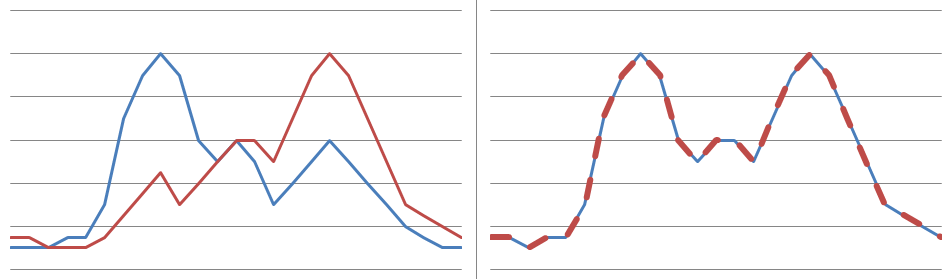
Traffic flow in a day per direction, the graph to the left is current flows, the graph to the right is the result of driverless taxis replacing private vehicles
This is the sum of flows in both direction, in green the current situation, in black the driverless taxi hypothesis
In the scenario pictured, which is typical of most roads in metropolitan areas, the number of car trips increases by 25% daily, and up to 50% during peak hours. This means total fuel consumption would increase by 25%. Imagine if this happened all over the world, what it would do for fuel prices.

The number of driverless cars needed to respond to the demand would be equal to the highest demand during the day. If in the worst time of the day, there is 1 million cars on the streets and roads at the same time, then you need 1 million cars. In the scenario I illustrated, I'd estimate that the needed number of cars would fall by about 75%, each driverless car would replace on average 4 cars, and maybe even less. These cars would also need to park somewhere when they are not currently being used, to avoid having them fill out streets, they would probably require holding areas outside of cities, and trips to and from these holding areas would add to the dead heading distance they would have to travel.

Okay, so this scenario leads to massive bidirectional congestion and massive increase in energy/fuel consumption. But is it a plausible scenario? Would people actually use driverless taxis to the exception of everything else? Would they kill both fixed route transit and private vehicles?

In a nutshell, no.

First, if they replaced transit, they would increase even more the number of cars on the roads, further increasing congestion and fuel consumption. Driverless cars do not solve the spatial problem of cars, they still require very wide roads, wasting valuable urban space.

Second, with all the dead heading they're going to do, it means that every time one uses one of them, they're going to need to pay for all the dead miles the taxis have to travel. Currently, the CAA (the Canadian version of the AAA) estimates that a car costs about 50 cents per km to use (80 cents per mile), without counting parking (which if counted would easily add another 20-30 cents). Much of the cost is depreciation, so let's say 40 cents per kilometer (64 cents per mile) assuming a very used driverless taxi, which has increased maintenance and acquisition costs because of the sensitive sensors. Now let's assume a reasonable amount of 50% of deadheading, that means that every mile traveled inside a driverless taxi has to pay for two miles. So now the cost is 80 cents per kilometer (1,28$ per mile). If the taxi companies are private, add 10% profit, we're up to nearly 90 cents per kilometer (1,40$ per mile). That's still much cheaper than current taxis, I've taken a taxi recently that cost me about 35$ to go 15 kilometers, so 2,33$ per kilometer (3,60$ per mile), but it's much more expensive than using one's own car or taking transit. For a more in-depth analysis of what driverless taxis might cost click here.

Therefore, the value proposition of these driverless taxis isn't that great, not unless many people take place in one. Transit operating costs vary between about 10 cents per kilometer per passenger (15 cents per mile) for heavily used subways (like in Tokyo, subways are profitable and can charge 3$ to go 25 km, but North American costs are probably more around 20-30 cents per passenger-kilometer) to 60-80 cents per passenger-kilometer for local buses (1,00-1,30$ per mile), with LRT and BRT falling somewhere in the middle. Subways still remain an immensely more efficient way to carry a lot of people around very fast, and buses aren't more expensive than driverless taxis and take much less space, but are much slower in general. Buses can also be made cheaper by making a better use of them. I know in Japan some local bus companies are often profitable while demanding the equivalent of 50 cents per kilometer (80 cents per mile) from users, and that's without articulated buses.

Also, one must consider the fact that if cars can be made driverless, so can buses. And big gains can be expected from this. If I go by the STM's budget, about 40% of bus operating costs comes from the drivers' wages. So remove drivers and buses' costs can fall to about 50 cents per kilometer (80 cents per mile) or less. Fixed route transit would thus be more efficient, at least in urban areas. In suburban areas, I could see driverless taxis replace the infrequent, inefficient suburban buses, or maybe some kind of driverless van, an hybrid between buses and taxis, with a fixed route but coming on call rather than being on a schedule.

Yes, I hear people whine "you're using passenger-kilometer for transit and vehicle-kilometer for cars!". Yes, I am, because most people travel alone by car, even in places where carpooling is more common, it's still a minority activity, because it is incredibly inflexible, you need to come from roughly the same origin and going to the same destination as someone else, at the same time. And I assume that people will not want to be with strangers inside a taxi without a driver. Alone, we feel safe. In a crowd, we feel safe. But there is a middle, when we're alone with one or two strangers in a closed space, where we really, really do not feel safe.

Worse, the value proposition of driverless taxis is terrible compared to private vehicles. Not only is the cost from private vehicles about 40% less, but private vehicles have the advantage of having most of the cost be fixed costs, with only limited marginal costs. In other words, once you've bought the car, paid the insurance, paid the regular maintenance, and all those fees that are not directly connected to your use of it... cars seem cheap to run, you just need to gas it up once in a while. Meanwhile, the driverless taxi would be a full-on marginal cost. Travel 10 miles, pay 14$. Ouch, right?

So that means that people who want to keep traveling by private vehicle are likely to not use the taxis but buy their own car instead. So this scenario of shared driverless taxis as the dominant mode of transport is just not that plausible to me. The economics are not there. In dense areas, transit is, or can be, much more economical and just as good in some cases (subways with development around stations so most destinations are within walking distances of them). In less dense areas, people who commonly use private cars to get around are much better off still using private vehicles rather than driverless taxis.

In conclusion

So, overall I do not expect self-driving cars, even when the technology is mature, to significantly change how people get around. People who use private vehicles to get around will still use private vehicles to get around, they just will be less likely to drive them themselves. Meanwhile, people who use efficient mass transit in urban areas, who are the majority of transit users in North America, are likely to keep using mass transit. Driverless taxis can make taxis much more affordable, but taxis are likely to remain a marginal transport mode, though they may make owning a car for occasional trips less worthwhile and increase car-less households in cities, even if these households would still mostly rely on transit and active modes of transport.

Transit in less dense areas may be more affected, especially if the technology filters to transit buses, as it would make them much more economical to run, and hybrid bus-taxis on fixed routes could really open up transit in less dense areas.

Tuesday, July 1, 2014

The importance of impressions: how on-street parking gives a false impression of car dominance on urban streets

On-street parking is one of the main points where I strongly disagree with the New Urbanists, I've already spoken about it a few times, but I wish to come back to it. New Urbanists tend to favor on-street parking for a few reasons:
  • For traffic-calming, cars parked on the street represent obstacles to moving cars and narrow the streets, which incites drivers to go more slowly and carefully
  • For pedestrian protection, as parked cars create a barrier of steel between moving vehicles and pedestrians on sidewalks
  • For aesthetic reasons, to keep the front of lots devoid of driveways and garages (often pushed to a back alley)
These two images are both from Markham's New Urbanist development, within hundreds of meters of each other...
...they illustrate what effect relocating driveways to back alleys and relying more on on-street parking has
 I don't really disagree with what they say, I just think that these things are true only based on certain assumptions, basically taking a classic American suburb then tweaking it rather than really challenging its basic design. I would counter:
  • It is better to have narrow streets with objects like walls, fences and trees bordering them than to rely on wide streets and the presence of temporarily parked vehicles to narrow them. When you build a wide street in prevision of on-street parking and there are few parked cars, the street is wide and incites speeding.
  • A barrier works both ways, if parked cars prevent cars from going on the sidewalk, they also create a psychological barrier for pedestrians to keep them off the street and on narrow sidewalks.
  • Though on-street parking does keep house fronts from being laden with garages and driveways, unbroken lines of parked cars are no better esthetically.
One of the points I would add against on-street parking, especially urban areas, is how much of a claim it represents for cars on urban streets. What I mean by that is that on-street parking leads to the near permanent presence of dozens on cars on urban streets, wherever you look, you will always notice large amounts of cars everywhere. What is wrong with that?

Impressions matter

I think we must not underestimate the effect that impressions have on people's willingness to favor or oppose certain reforms. The fact is that the constant presence of dozens of cars on an otherwise pedestrian-oriented street gives the impression that cars are much more numerous and essential than they really are. This impression then supports the feeling that we cannot afford to take space away from cars. Cars are always occupying most of the space that was given to them, so if anything, the feeling we get is that they need more space, not less.

But in truth, on many urban streets, cars are actually pretty few, here is an example I've spotted recently, Sainte-Catherine street in Montréal, a main commercial arterial I've talked about many times. It's a one-way street with two travel lanes and parking on both sides of the street. Here are some pictures I took of it last week. This was a bit after the Friday PM peak, around 6 to 7 PM.


There's a lot of cars, isn't it? In every photo there is a least a dozen cars in the foreground. But what happens if I remove the parked cars? Sadly, I don't have Photoshop, but I'll add black blocks to cover them.

On this long stretch of road of maybe one kilometer, there's less than a dozen car (and a bus) visible
On this 150-meter block, there's 4 cars visible
Good visibility up to 300 meters and only 6 cars visible
Just one car on its lonesome in a space around 1 000 square meters in area (150 meters times 6 meters).
In all these cases, there tends to be one car moving per 30 to 100 meter of roadway. That's a quite small amount of cars traveling on the street. Meanwhile, the sidewalks are full, not least because about half the sidewalk is given over to trees or crap like parking meters and poles.

Of the 20-21 meters of right-of-way, fully 60% (12-13 meters) is given to cars, despite how few there are
Worse, only about half the sidewalk is a pedestrian corridor, the rest is a buffer for poles, trees and parking meters
Another section of Sainte-Catherine street, in green the pedestrian corridor, in orange the buffer zone for fixed objects
Any proposal to reduce the space for cars gets met with roars of disapproval and shock. And why shouldn't they? There are tons of cars parked permanently on the street, even when one leaves, another takes its place. So visually, people feel like cars actually need all of their space, meanwhile, half the sidewalk is largely empty because objects block the path of pedestrians and force them to stick to an unobstructed corridor that's only half the width of the actual sidewalk. Even pedestrians come to feel like car drivers need all the space they currently have, and maybe more.

That is part of what I mean when I say parked cars "claim the street for cars". The other part is in how they signal to pedestrians "stick to your sidewalk, on the other side of us is car space". Parked cars are like flags flying on the street, reminding us all that "the street is for cars". 

Out of sight, out of mind... but when you're always in sight, how can people ever get you out of their mind?

By the way, why put objects so far from the curb into pedestrian space? My guess is because parked cars are too close to the curb, so we put poles, trees and other fixed objects far from the curb to keep a buffer between them and cars and to allow car passengers to exit without dinging their door on objects near the curb. On the other hand, if you'd have 4 travel lanes rather than 2 lanes and 2 parking lanes, since moving cars stick to the middle of their lane rather than hug the curb (people maintain buffers while driving, but once parked want their car to be as far from moving cars as possible), you don't need to put objects far into pedestrian space.

In this image, moving cars are red, parked cars are blue and pedestrians are in green. The black circle is an object (pole, tree, etc...). On the left, it's a 2-lane, one-way street with parking like Sainte-Catherine, on the right, it's a 4-lane 2-way street without parking. As the cars next to the curb are farther from it if they're moving in their own lane rather than parked, objects can be moved closer to the curb while maintaining the same buffer with the closest cars.

My point is that impressions matter, and parked cars maintain the impression that cars are far more present and essential to the health of urban areas than they really are,. If we remove cars parked on the street, I think it would make it easier to get people to support narrowing streets or to reintroduce two-way streets.

Though here I spoke specifically of one street in Montréal, I think the same observations could be made on a lot of streets all over North America.