Wednesday, September 10, 2014

Montréal and Sapporo

Though the Japanese city of Sapporo is most similar to the Texan cities in terms of how its core was initially built, I cannot help as a Montréal resident to notice the many similarities between the two cities. To the point where I have called Sapporo "Japan's Montréal".

  • Both cities have harsh winters with plenty of snow. Montréal's winter is a bit colder, and Sapporo is much snowier, but they face much of the same challenges with the winters:
Monthly average temperatures (in celsius) for Montréal and Sapporo
Monthly average rainfall and snowdall

  • Both cities have rubber-tired subways, initially built in expectation of international events, namely the international exposition of 1967 in Montréal and the winter Olympics of 1972 in Sapporo.
  • Both cities were the hosts of Olympic games in the 70s, the winter games of 72 in Sapporo and the summer games of 76 in Montréal. Both have kept traces of these events, the Olympic Stadium is the most recognizable building of Montréal and Sapporo still maintains the ski jump tracks built for the Olympics, using them as museum of winter sports and has vantage points for the city.
  • Both cities are pioneers of bikesharing in their respective countries, Montréal has BIXI, Sapporo has Porocle (for Sapporo Cycle... the only thing I'd say in defense of the name is that it looks better in katakana).
Porocle, Sapporo's bikesharing program, sponsored by... KFC?
BIXI, Montréal's famous bikeshare,which served as the basis for the Citibikes in New York
  • Both cities have underground malls in the downtown area. Sapporo has Aurora Town under Odori park, Montréal has the RÉSO (30 kilometers of underground tunnels, making it, according to some sources, the largest underground city complex in the world).
  • Both cities are known for beer. Many have heard of Sapporo because of the beer and probably don't know it's a city in Japan. Montréal is the home of Canadian beer giant: Molson, and has breweries from the other Canadian beer giant, Labatt. Both cities have a local craft beer industry of note.
  • Both cities used to be inhabited by native people ultimately displaced through colonization: the Ainu in Sapporo (in fact, Sapporo is not a Japanese word, but the transliteration of the Ainu name of the region). Montréal was founded on the former Iroquois village of Hochelaga, which name is still used to describe a neighborhood of the city.
  • Both are located on plains with nearby farms, with hilly regions close.
  • Both have messy, fat local food. Sapporo has the Jingisukan (Genghis Khan), which consists of mutton cooked in a copper bowl on which a piece of lard has been melted beforehand. Montréal has poutine, if you don't know what it is, you don't know what you're missing.
Sapporo's jingisukan... they actually give you a plastic apron to ward off the splatter of melted lard that inevitably happens

Poutine! Fries, gravy sauce and cheese curds put all together. This particular one also has sliced sausages

I hope I have made my case for the similarities between the two cities. Anyway, I'm not campaigning for twinning the cities and organizing a Montréal-Sapporo festival... yet. This is an urbanist blog, so let's look at the development models of the two cities.

Urban models of development: Sapporo and Montréal

Montréal and Sapporo follow two very different urban regulation models. Montréal is quite uniform overall, being a bit European in the sense that it has entire neighborhoods of 2-3 story buildings packed really closely together and tends to favor uniformity with zoning regulations.
Multiplexes in the Plateau-Mont-Royal borough, built in the early 20th century
Lasalle, a 1970s-suburb, this particular area is made up of only 2 housing model, duplexes with front-loading garages and 4-plexes (2-story, 4 units, plus one in the basement) with side-loading garages (not shown here), in many ways an adaptation of the Plateau but with priority given to cars rather than transit
Meanwhile, Sapporo follows the Japanese model that results in eclectic neighborhoods, with multi-family and single-family housing close together, with occasional mid-rises/high-rises in otherwise low-rise areas. The one uniform trait is that tall buildings tend to be on wide streets (regulations capping building height with street width) and near transit stations, and that buildings on narrow streets are almost all low-rise. This model is much better at allowing cities to evolve and grow, whereas the European-inspired model of Montréal is hostile to rapid area changes. It also enables mixed used development much more readily.


A 10+-story apartment bloc towers over a street of low-rises
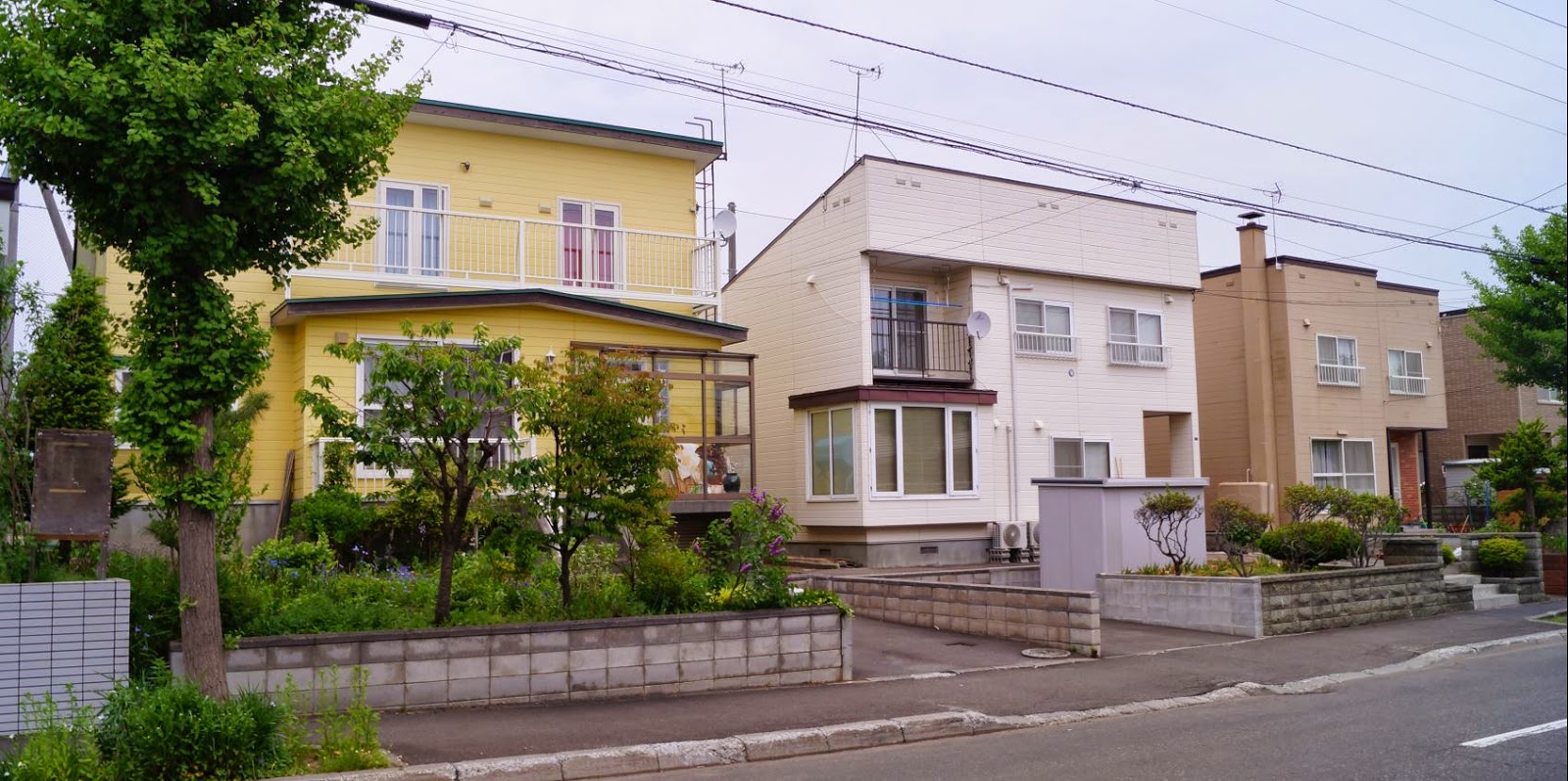
All of these are single-family houses, but even then they manage to be eclectic, with each house being of a different model
This is THE exception I've spotted where the same apartment bloc model was built en mass on a section of a street
Unfortunately, I seem not to have taken pictures of the Shinsapporo (new Sapporo) station area, which suffered from severe "tower in a parking lot"-itis.

What is the result of these two modes of development?

Some data

First of all, images of Sapporo and Montréal from the sky, where you can see urban development and how it spreads:
Montréal, the core city occupies most of the island
Sapporo
Montréal's suburbs seem to develop in nodes, because of the agricultural protection law, which limits how cities can sprawl, by limiting developments to "white zones" centered around old villages, causing developments to "skip" agricultural fields. Sapporo develops more as a mass radiating from the center.

Now, to compare the size just of the two core cities of the metropolitan areas, excluding inhabitable water, hills and other cities.

Sapporo to the left, Montréal to the right: quite similar in size
 Now, the population of each core city and the population of the respective metropolitan areas:
  • Population of the core city
    • Montréal: 1 621 000
    • Sapporo: 1 914 000
  • Population of the metropolitan areas
    • Montréal: 3 821 000
    • Sapporo: 2 606 000
  • Share of the metropolitan population residing in the core city
    • Montréal: 42%
    • Sapporo 73%
So Montréal's metropolitan population is much higher than Sapporo's. Yet, Sapporo's population is greater than Montréal's, and denser.

What is of greater interest is where residential constructions are happening right now.
  • Number of new residential units, average from 2004 to 2006, for the core cities
    • Montréal: 8 767
    • Sapporo: 21 600
  • New residential units, average from 2004-2006, metropolitan areas
    • Montréal: 24 538
    • Sapporo: 27 367
  • Share of new units built in core city, average 2004-2006
    • Montréal: 35%
    • Sapporo: 79%
New housing units per year, for the years I could find data for
What's interesting here is that, if we use new housing as a proxy for where new residents go to, in Sapporo, despite the higher density of population than Montréal, most new constructions happen in Sapporo itself, not its suburbs. In fact, the share of new constructions being built in the core city is higher than the city's share of metropolitan population (79% of new housing, 73% of population), meanwhile the opposite is true in Montréal (35% of new housing, 42% of population). What this indicates is that the city of Sapporo is growing faster than its suburbs and is likely to maintain a major share of the metropolitan population. Meanwhile, Montréal's metropolitan area is sprawling, suburbs are growing much faster than the core city which is choked by its inability to keep growing housing supply to deal with rising demand, a problem that doesn't affect Sapporo it seems.

Montréal also suffers from a much more developed freeway system, which are free to use (apart from a recent bridge that has a modest toll). This allows suburbs to spread much farther than in Sapporo.
The freeways are in orange, notice the dense network in Montréal and contrast with the few freeways of Sapporo that go around the city

Subway and TOD

The ability to add housing where it is in demand also leads to an interesting effect regarding the subway. 

First, let's look at the two subway systems:

Montréal's and Sapporo's subways to scale
 If you have the impression that Montréal's subway system is bigger, that's because it is.

  •  Number of stations
    • Montréal: 68
    • Sapporo: 48
  • Track length
    • Montréal: 69 km (43 miles)
    • Sapporo: 49 km (31 miles)
So Montréal's subway network is more extensive. is it a clear win for Montréal? Not quite.

  • Subway ridership
    • Montréal: 219 million passengers per year
    • Sapporo: 210 million passengers per year
  • Annual ridership per kilometer of track
    • Montréal: 3,16 million passengers/km
    • Sapporo: 4,29 million passengers/km
  • Annual ridership per station
    • Montréal: 3,22 million passengers per station
    • Sapporo: 4,38 million passengers per station
So overall, both subway networks serve roughly the same population, but in terms of ridership per station or per kilometer of track, Sapporo's subway is much more effective, offering 35% more riders than Montréal's subway.

What gives?

Well, my theory, from having seen Sapporo and Montréal up close, is that the Japanese mode of development is much more conducive to TOD than Montréal's European-flavored mode of development. Indeed, I've pointed out recently that many of Montréal's subway stations that have been around since the late 60s have seen little to no redevelopment around them, with many areas being severely below optimal density, with few jobs or attractive commercial areas around. Meanwhile, areas around transit stations in Sapporo, whether in the downtown area or in the fringe of the network, tend to attract high-rise residential blocks and compact, urban-styled malls. Since Montréal's zoning prevents these from happening in areas that are already built, malls and high-rise developments occur outside the subway network's coverage, inciting people to take cars to reach these developments.

Here is a prime example:

This is a mall located at the edge of the Green line of Montréal's metro, the Carrefour Angrignon. The mall was built years after the metro was built.
Carrefour Angrignon and Angrignon metro station
The mall is not only of a typical suburban form, surrounded by plenty of parking, but it is located at a 10-15 minute walking distance from the subway station. What is built over the subway station then? Nothing, nothing at all. There's just a corner store in the station itself and a surface bus terminal.

Meanwhile, let's look at a mall likewise located at the end of a Sapporo subway line and contrast:
Mall near Miyanosawa station
I've taken pictures of this mall while on my trip to Sapporo:

The only parking lot in front of this suburban mall is a bike parking lot
Cars must take the ramp to their own parking upstairs
This is an urban, compact mall with parking built over the mall rather than around it. It is also much closer to the station, a mere 2-minute walk away, it's even connected to the station with an underground passage for the winter.

Montréal's subway performs very well in terms of ridership for a North American subway, but the reality is that this is mainly due to two things:
  1. The presence of dense streetcar suburbs connected to the downtown area by the subway
  2. Express buses and commuter rail feeding the subway network by connecting to the downtown area, then having users take the subway to distribute themselves around Montréal
There has been very, very little TOD in Montréal apart from some construction downtown, and the station on the South Shore, in the suburb of Longueuil, which was in an undeveloped area that is enclaved by highways on three sides, making it disconnected from the rest of Longueuil.

Sapporo also has a much better performing regional rail system, while Montréal has a few piecemeal commuter rail lines. 76 million people take trains each year in Sapporo, versus 19 million taking commuter rail in Montréal.

Where Montréal beats Sapporo hands down in transit use is the bus system, just the core city's bus service carries about 240 million passengers each year (suburban bus services can add maybe another 80 millions), versus 105 millions for Sapporo's now private bus networks. But where some might see this as a positive, I will see as a negative... Sapporo's mode share shows that though people use transit a bit less, they walk and bike in much greater numbers than in Montréal. The result I guess of strategically placed density and mixed use. Where Sapporo residents would walk, Montréal residents might have to take the bus, because the area is car-oriented and inhospitable to pedestrians.

Mode shares of Sapporo and Montréal

I think that in a well-built city, dense, with a good mix of uses and with decent biking infrastructure, the role of buses is essentially a niche role. Buses, because of the wait times and the high number of stops, are slower than bikes in urban areas. And below about 800 meters (half a mile), walking, at least for an healthy adult, is likely to be faster than taking the bus, even a frequent one with headways of 10 minutes, once one takes into account the waiting time and the detour to get to bus stops, even if the bus line goes straight to the destination.

Conclusion

OK, so what do I gather from this analysis? First, that lax zoning is a boon to transit investments, as it results in automatic TOD which maximizes transit use on rapid, high-capacity lines. The Japanese mode of development, chaotic as it is, makes it less necessary to build very large subway networks as developments concentrate along the lines and reduces the need to extend the network further.

Second, the Japanese model of development keeps core cities strong by allowing a lot of new housing to be built in them, so less people are forced to move out due to housing shortages. Indeed, going by the new units' data, it seems that Sapporo will grow faster than its suburbs in the near future, whereas Montréal is stagnating and allowing its suburbs to grow at a much faster pace, losing more and more to sprawl, a fate that is common to most North American cities.

I have not spoken of housing prices, but I must point out that Sapporo is a very affordable city by most standards, even compared to Montréal, which is pretty affordable for a big Canadian city. Here is a short report on average housing prices provided by Suumo.jp for the central ward of Sapporo.
 
If you can't read Japanese , what this says is that the average price for a studio is around 300$ per month, 400$ for a 1-bedroom apartment, 700$ for a 2-bedroom apartment and 900$ for a 3-bedroom apartment. In the downtown area. The sample size is low, but old condos of more than 770 square feet sell on average for 175 100$, meanwhile single-family houses sell for about 330 000$.

Some people say higher densities correlate with higher housing prices. This doesn't seem to be the case for Sapporo.

Again, much can be learned from the Japanese mode of development. Though some may be put off by the resulting dense neighborhoods of eclectic buildings, it seems to me that we ought to reform the way we build cities more in the Japanese way. Without necessarily dropping everything and copying them wholesale, there are quite a few aspects of their way of doing things that ought to be emulated.

Saturday, September 6, 2014

The sprawl tax: how sprawl makes us all poorer

One of the main effects of sprawl is the imposition on residents of a lot more miles of travel to satisfy their daily needs, whether it is work,. school, cultural activities or shopping. All these miles add up, and generally the only way to be able to travel around without wasting half of one's waking day walking or biking around is to use cars. The result is that to be a functional member of society in sprawl, you essentially require a car, in fact, one car per working adult in every household.

This comes at a cost, of course. Walking is free, biking is nearly free, transit is comparatively expensive, but cars throne over all of these modes of transport in terms of how expensive they are. According to the AAA, a small sedan used for 15 000 miles a year costs nearly 7 000$ to the owner. If you buy used, you save some money, but not all that much of it. Edmunds, a car website, has a "true cost to own" metric which indicates for instance that the total 5-year cost to own and use a 2009 Honda Civic bought secondhand is around 29 000$, or 5 800$ per year.

Since buying a car is almost a requirement in sprawl because of the distances people have to travel each day, and that cars are extremely expensive to own and run, the result is what I call the "sprawl tax": the fact that building sprawl and living in sprawl comes with a high transport cost that drains people's pocketbooks and which they cannot avoid, just like taxes. People have to work, have to buy food, have to get out of their home sometimes to satisfy their needs, and when they do, they need a car if they live in sprawl.

Transport versus taxes, which cost us more?

I live in Québec, so I'm going to start with Québec. We are often considered the most taxes jurisdiction in all of North America. Income taxes paid to the provincial government top out at 25,75% over 100 000$ of income, which are added to federal income taxes of  up to 24% (it's 29% in the rest of Canada, because Québec has taken on more responsibilities, the federal income tax is 16% lower in Québec than in the rest of Canada). Of course, we have a lot of tax credits, like everywhere else.

Overall, Québec households paid on average about 11 000$ in income taxes, 5 800$ of which went to the provincial government. In comparison, they paid about 10 000$ in transport. The cost of transport is thus equivalent to the cost of income taxes.

In Canada overall, households paid about 11 000$ for transport and 13 000$ in income taxes. Again, the cost of transport would be nearly equivalent to income taxes. However, according to another data source, total consolidated government revenue from income taxes in Canada are about 250 billion dollars, the equivalent of 19 000$ per household.

In the United States, the income before taxes of households is on average around 65 000$, and after taxes, about 60 000$, so income taxes should be about 5 000$ per household Shane Philipps commented below that the amount of federal income tax revenues in the US alone equal 11 000$ per household, he is correct, there is a major discrepancy between data sources that is hard to explain. Maybe government transfers and certain tax credits are counted as negative taxation in the BLS survey. In comparison, households spend on average 8 999$ on transport, which is nearly 80% more than households pay in income taxes. which is more than 80% of what they pay in federal taxes.

So transport costs in North America are as high or higher than what households pay in income tax. Now, not all these costs are directly due to sprawl, some are reasonable transport costs in developed countries, so let's do some international comparisons to see how denser, less sprawling countries spend on transport.

How much money does sprawl cost households?


First of all, according to the OECD, American households spend in total, 1,11 trillion dollars each year on transport, the equivalent of around 3 600$ per capita, including the young and the old. The reality is even worse than it looks, as Americans subsidize transport quite a lot. This amount does not include the cost of parking, whether residential or commercial, nor does it include the tens of billions of dollars spent each year from taxes to pay for the freeway system or local streets. According to the Tax Foundation, of the 155 billion dollars spent each year on highways, only 50% comes from "user fees" that would appear as part of the transport costs reported by the OECD. Once you include those costs, the cost per capita increases to nearly 3 800$ for transport.

Canada is actually even worse, with Canadians spending 156 billion dollars per year on transport, or nearly 4 500$ per capita, 4 100$ if converted to American dollars.

Meanwhile, according to the same data source, Europeans, despite driving being more expensive as it is less subsidized, spend only 2 700$ per capita. An economy of more than 1 000$ per person, per year. According to the OECD, the Japanese pay even less, around 2 500$ per capita.

Transport spending per capita per the OECD, in American dollars

That is only one data source, other data sources often reveal different things. For instance, the Family and Income Expenditure Survey of Japan has much different data, with households reporting an average of about 35 000 yen per month (350$) in transport and communication (yes, the Japanese survey shows the monthly not yearly cost and bundles transport with communication). Once we remove communication costs and annualize the amount, the result is about 3 000$ per household per year, and each household has 2,44 people in it, so the per capita cost would be about 1 250$! Half of what the OECD says, and a third the transport spending of the United States.

For the record, the BLS expenditure survey shows that each American household spend 8 999$ per year on transport, with an average of 2,5 people per household, that's about 3 600$ per person. Though households in core cities spend only a little over 7 000$, and around 3 000$ per person. Suburban residents pay the most, almost 10 000$ per household, 4 000$ per person. People in rural areas have costs in between.

Statistics Canada reveals that Canadian household spend 11 229$ each year on transport, or 10 300$ in US dollars, around 4 000 $ per person. So both these numbers are close to the OECD ones, but not the Japanese numbers.

Conclusion

Overall, transport costs are 20% higher in North America than in Germany or France, 40% higher than in Europe and 50 to 200% higher than in Japan (depending on whether one believes in the OECD or the Japanese household expenditure survey). I'm not even going to use the latter Japanese figure, to avoid accusations of confirmation bias and selecting the data most favorable to me.

So to compare with the income tax, the "sprawl tax", the excess transport spending caused by the sprawl mode of development, is equivalent to 15-30% of total income taxes for Americans, and 15-25% of total income taxes for Canadians. 

Which means that if we rehabilitated our cities and moved towards more urban development instead of suburban development, the benefits in lesser transport costs would be the financial equivalent to a 15-30% income tax cut for Americans, and of a 15-25% income tax cut for Canadians. If all the discussions of quality of life, of "public places", of climate change cannot convince you to back urban revival over sprawl, then remember this: turning your back on sprawl would be as beneficial for your pocketbook as a massive income tax cut of up to 25%.

Of course, these savings depend on individual decisions, people who choose to live far from everything else and drive everywhere, even in places with good transit service and high density in urban areas, would still spend as much as before. But the important thing is that people have a CHOICE, to spend money on transport or not, something they do not have in sprawl.

One hint of this dynamic is that spending on transport in the bottom quintile (the poorest fifth of the population) in the United States is around 16% of total spending, which is the same proportion as the richest quintile. This means that though the poor try to cut on unnecessary spending, the necessary transport spending of sprawl makes them unable to lower their share of spending on transport to dedicate to more pressing needs. Meanwhile, in France, the bottom quintile manages to spend just 11% of their spending on transport, versus 16% for the rich. Same thing in Japan, where the bottom quintile spends just 6,0% of their total consumption spending on transport, while the richest quintile spends 11,1% of theirs. So in Europe and Japan, people who want to save money can cut on transport significantly while remaining active and functional, not in the United States.

Tuesday, September 2, 2014

Filtering vs gentrification

Just about everyone has heard about gentrification: a phenomenon where a neighborhood that used to be middle-class or even poor gets a new influx of newcomers, changing the social makeup of the area. It is associated with increase in rents and housing prices. However, it's important to note that in general, the rich will not be satisfied with the housing of the poor, they will demand housing which, in size, quality and amenities, fit their desires in term of housing. Though high-rise condo towers are often the poster child of gentrification, gentrification also occurs in low-density areas when the area becomes desirable. It's the phenomenon of the "monster home" for example, where an old house is torn down to be replaced with a house as large as zoning allows:
In Vancouver, older houses to the right, monster house to the left
Though tearing down housing and replacing them is what a lot of people think when they think of gentrification (shiny high-rise towers have quite a psychological effect), much gentrification occurs in a very different manner, through renovations of buildings, merging units (duplexes being converted to "cottages" is a common case in Montréal), adding extensions, digging basements, etc... In fact, gentrification can very well occur without leaving any mark visible from the street, some renovations are so thorough that essentially all that's left of the old building is the exterior walls, and thus affordable apartments are turned into luxury apartments.

But there is another phenomenon where higher class housing deteriorates and becomes less desirable over time, allowing people of lower socio-economic status to be able to afford it. This is what is known as "filtering". This may be somewhat shocking to learn for some as it's not what we hear about in general. Still, it has been seen, for example in Japan where old housing tends to be significantly cheaper than new housing, for instance, this 70-square-meter (760-square-foot) condo apartment, or "mansion" as the Japanese say, built in 1969 sitting right on top of a subway station at 15 minutes from Shinjuku station is being sold for the equivalent of 230 000$ (searches for recent condos of similar sizes reveal that prices start at 550 000$ for ones built within the past 5 years), or in places like Kansas City, MO where there are plenty of turn-of-the-century (well, early 20th century) houses selling for extremely low prices.

Why do some places see gentrification while others see filtering? Can we get housing to start filtering instead to sate our needs for affordable housing?

Let's talk about cars...

I think this analogy is good to understand the dynamic behind these phenomena. Cars are a prime example of filtering, the new car sold at 20 000$ is perhaps worth 10 000$ or less 5 years later, even if it is a low-mileage car. In developed countries, the secondhand car market has been what allowed the poor to afford cars that they could never have bought new. Why is it that cars' value go down while houses' value are not supposed to actually go down?

Well, new cars have warranties, old cars don't... but that's the case for housing too in general, new homes tend to be covered by warranties offered by the home builder (sometimes required by law).

Well, cars' likelihood of breaking down increases over time... but so do houses, over time they will also require renovations and replacement of certain parts (the roof for instance).

So why are old cars worth less than new cars? Even cars that have been well-maintained, covered by extended warranties and in perfect condition are worth less than new cars.

I think the reason is that old cars have to compete with new cars, and it is extraordinarily rare that a new model is not better in some ways than an older model. The engine and transmission may be better, more fuel-efficient and/or powerful. The design may be more modern and more comfortable. More amenities may be added to the car, etc, etc... Car manufacturers don't really have a choice, their cars must compete not just with other brands' cars, but also with their older model.

Considering that, why would anyone be willing to pay more for an old car than a new car when new cars are often so objectively better?

That's why old cars see their value go down over time, because we keep building new cars and these cars keep getting better and better. We could theoretically keep old cars around and just upgrade them, change the engine, change the transmission, redo the interior, etc... That way we could insert new technologies in older vehicles, but it's considered too much of a bother versus buying new cars instead, that come with all this new technology right out of the car dealer's parking lot.

But imagine if we suddenly decided "we have too many cars already, let's put a quota on the amount of new cars we can build, or even ban making new cars altogether". Suddenly, because you have no influx of new cars on the market and you're stuck with the old cars, their value would cease going down, because they have no more competition from new cars. In that context, if something breaks on a car, people will fix it instead of scrapping it, and people may start replacing old engines with new ones instead of buying new cars.

Since new cars couldn't be built, it would also mean that the supply of cars in the market would be stagnant, if population and wealth is growing, it would mean that cars' value would get higher and higher all the time and a smaller and smaller share of the population would be able to afford them.

This is not merely theoretical, it has happened in real life. After the Cuban Revolution, the United States started an embargo on Cuba, which included, of course, cars. The USSR struggled to build enough cars for its own people, so it couldn't pick up the slack from the loss of access to American cars. Cuba itself had no car-making industry. The result was that the stream of cars dwindled to nearly nothing in Cuba. Without the ability to replace existing cars, Cubans have developed an expertise in keeping their old 50s-era American cars on the streets, repairing and replacing parts as they failed, decades after most of the cars' "brothers" have been scrapped as useless junk in the United States.

Whereas the car market in North America is a classic example of "filtering", the market in Cuba might be much closer to "gentrification", with cars maintaining their value and upgrades the only way to get better cars.

Now back to housing

In general, the North American market for housing is closer to the car market in Cuba, at least in urban housing. The unwillingness of communities to allow the replacement of old housing and the focus on preventing areas from evolving means that new housing can scarcely be built. Yes, they do manage to find ways to build a few new units, but not in any kind of quantity required to sate demand for housing.  Since there is little competition from new constructions, people have to make do with old housing and renovations to upgrade them to a quality level people deem acceptable. What few new constructions exist often have distinctly higher prices, a sign that people are willing to pay more for modern housing that is generally better designed and better built (despite certain rants about supposed new "poor quality" condos... I've seen old apartments and new condos, there is no question for me that newer condos are significantly superior unless old apartments have actually been rebuilt from the ground up).

So without the ability to add enough new housing supply to satisfy the demand for housing, gentrification is the result. Old houses are repaired and upgraded rather than replaced. Growing populations and demand for urban housing means that by default some people have to be excluded from urban areas for lack of housing. Richer people buy older urban housing just to upgrade them through renovations, or through rebuilding, to make them fit their expectations.

On the other hand, filtering is sometimes seen in sprawling cities which have not yet hit the borders of their growth and where freeways and the destruction of density have made location much less important as there is little attractive location left. In this case, richer people will prefer buying new houses in new subdivisions built at the fringe of the city rather than older houses in older subdivisions. That's why new housing is still being built in cities with declining populations despite current housing stock being adequate to satisfy demand.

So the way to end gentrification and start the process of filtering is to allow for significant increases in supply for urban housing. This means not just allowing old building to be torn down and replaced, but allowing new constructions to be of higher density, to add housing supply. Destroying a house to build another house doesn't help. You can either build out (sprawl) or build up, and building out is not possible for built-out urban areas, even if you build new housing on the outskirts, as location matters, this housing will not reduce pressure in the urban area itself.

This means that even if all new constructions are luxury housing, it doesn't mean that people who aren't rich will not benefit from it. For instance, if you have a subway station in an area and rich people want to move there, preventing the construction of high-rise condos near the station is not helpful at all to prevent gentrification. Those people will just then buy currently affordable housing and renovate them into housing that fits their criteria. If you don't allow the rich to concentrate in new high-density housing, they will just spread out in lower-density areas and transform old housing into luxury housing instead.

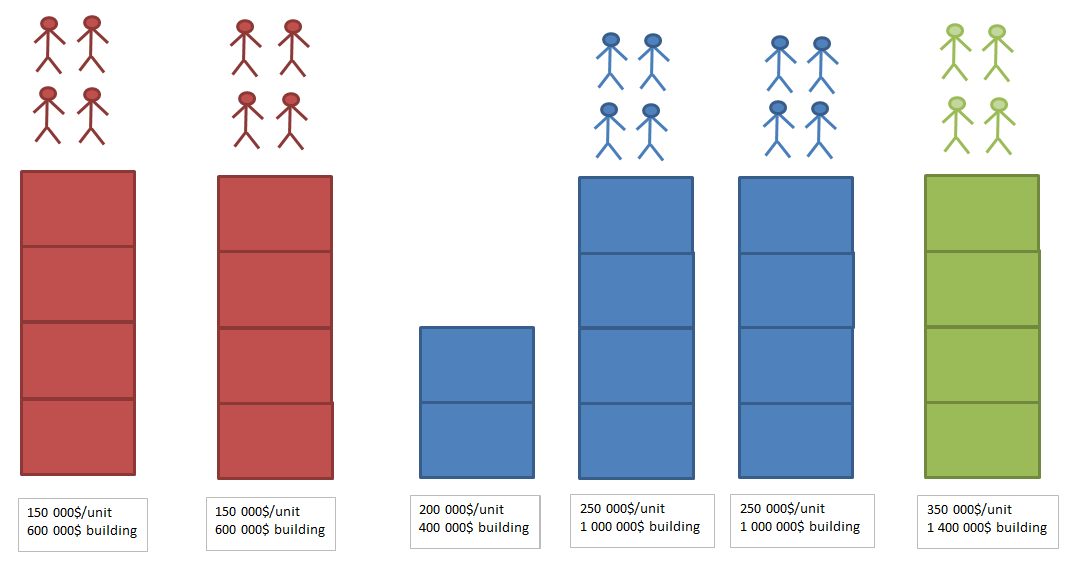
Let's make a simple representation of this concept. Here is an image representative of a mixed middle-class and poor neighborhood.
Here, each stick figure represents an household, each block an housing unit, the blocks are stacked to represent buildings. Red represents poor households and affordable housing units. Blue represents middle-class households and housing units. Green, which we will see in a moment, represents rich individuals and luxury housing units.

Now let's say the area becomes highly desirable, and rich people want to move in, and they want housing units that are worth 350 000$ or more and they tolerate high densities.
 
So here is one way they could be fitted in the current area, by replacement of a previous building with an higher, more luxurious bloc with more units. The building replaced will be a middle-class housing because it's more affordable to buy than the poor tenements as they have less units. Another middle-class building may also be replaced by an higher density middle-class building to welcome the previous occupants of the other building torn down to make way for the luxury housing building. The result would be this:
Here, density increased to allow everyone who wants to live in the area to do so. No one has been evicted from the area.

What happens if a promoter looks at this and says "Huh, so I can replace a middle-class building with an higher density middle-class building and make profits doing so? Then I will replace another of the 2-units building with a 4-unit building, which will attract the four remaining middle-class household not in high-density housing."? In essence, even more housing will be built. This will be the result:
Okay, so now the 2-unit middle-class housing is unoccupied, which means the owner will lose money on it and be willing to sell for a smaller price. This may draw out some of the poor households who can afford a somewhat more expensive, but higher quality, housing unit. I'll draw them in orange.
This is filtering, more precisely, the 2-unit middle-class building has just been filtered down and become more affordable. You have two unoccupied affordable housing units, which will create a pressure to keep prices down for affordable housing. Poor households move into middle-class housing units, that are a bit more expensive, but also higher quality than where they used to live.

But what happens if the NIMBYs and anti-gentrification activists who don't want rich people coming into the neighborhood come out and block the construction of higher buildings in the area by derailing zoning changes? Then the high-rise luxury building cannot be built. Will the rich leave, sad at being defeated? No, they won't, they will buy middle-class housing and renovate them to their taste. The middle-class people who lose their housing will in turn do the same to the poor people, taking over one of their buildings and renovating the units to be more pleasant for them. What happens to the poor who lose their affordable housing then? Well, they get kicked out of the neighborhood by lack of affordable housing. This is gentrification.
Alternatively, the rich could outright take over one of the affordable buildings, but housing size may be too small for them, and the end result is still the same, poor households get kicked out of the neighborhood.

Conclusion

What determines whether gentrification or filtering occurs is the amount of new housing that can be built. When enough housing can be built to satisfy new demand for housing, this will free up older housing units and allow their value to fall and become affordable for other people. The only way for old housing to filter down and fall in value is to make sure that old housing has to compete with new housing, just like old cars have to compete with new cars.

I've said it before, but it deserves repeating: limiting density and the construction of new housing supply brings about gentrification. On the other hand, succeeding in building more housing than the strict minimum required to accommodate newcomers will achieve filtering, as the more attractive housing draws rich and middle-class people, the vacated luxury or middle-class housing will fall in value to be affordable for people of a lower socio-economic class.